Source: http://www.hiponline.com/artist/music/c/collective_soul/
Kamis, 09 September 2010


Black Sabbath Biography

Formed 1967, Birmingham, England
Mixing equal parts of bone-crushing volume, catatonic tempos, and ominous pronouncements of gloom and doom delivered in Ozzy Osbourne’s keening voice, Black Sabbath was the heavy-metal king of the Seventies. Despised by rock critics and ignored by radio programmers, the group sold over eight million albums before Osbourne departed for a solo career in 1979 [see entry].
The four original members, schoolmates from a working-class district of industrial Birmingham, first joined forces as Polka Tulk, a blues band. They quickly changed their name to Earth, then, in 1969, to Black Sabbath; the name came from the title of a song written by bassist Geezer Butler, a fan of occult novelist Dennis Wheatley. The quartet’s eponymously titled 1970 debut, recorded in two days, went to #8 in England and #23 in the U.S. A single, "Paranoid," released in advance of the album of the same name, reached #4 in the U.K. later that year, it was the group’s only Top Twenty hit.
The single didn’t make the US, Top Forty, but the Paranoid LP, issued in early 1971, eventually sold four million copies despite virtually no airplay. Beginning in December 1970 Sabbath toured the States relentlessly. The constant road work paid off, and by 1974 Black Sabbath was considered peerless among heavy-metal acts, its first five LPs all having sold at least a million copies apiece in America alone.
In spite of its name, the crosses erected onstage, and songs dealing with apocalypse, death, and destruction, the band members insisted their interest in the black arts was nothing more than innocuous curiosity (the sort that led Ozzy Osbourne to sit through eight showings of The Exorcist), and in time Black Sabbath’s princes-of-darkness image faded.
Eventually, so did its record sales. Aside from a platinum best-of, We Sold Our Soul for Rock ‘n’ Roll (1976), not one of three LPs from 1975 to 1978 went gold. Osbourne, racked by drug use and excessive drinking, quit the band briefly in late 1977 (former Savoy Brown- Fleetwood Mac vocalist Dave Walker filled his shoes for some live dates). In January 1979 he left again, this time for good. Ronnie James Die, formerly of Ritchie Blackmore’s Rainbow, replaced Osbourne.
Although Dio could belt with the best of them, Sabbath would never be the same. Its first album with Dio, Heaven and Hell (1980), went platinum, its second, Mob Rules (1981), gold. But thereafter, the group’s LPs sold fewer and fewer copies, as Black Sabbath went through one personnel change after another. III health forced Bill Ward out of the band in 1981; Carmine Appice’s brother Vinnie took his place. Friction between Iommi and Dio led the singer to quit angrily in 1982, he took P with him to start his own band, Die. Vocalists over the years have included Dave Donato; Deep Purple singer Ian Gillan; Glenn Hughes, another ex-member of Purple; Tony Martin; and Dio again.
By 1986’s Seventh Star, only Iommi remained from the original lineup. He had to wince when Geezer Butler teamed up with the phenomenally successful Osboume in 1988, though the bassist did return to the fold three years later. Despite bitterness expressed in the press between Osbourne and Iommi, the original foursome reunited in 1985 at the Live-Aid concert in Philadelphia, and again in 1992, at the end of what was supposedly Osbourne’s last tour. Throughout 1993 word had it that Osbourne, Iommi, Butler, and Ward would tour, but by year’s end Osbourne had backed out, allegedly over money. The indefatigable Tony Iommi went right back to work with Butler, rehiring vocalist Tony Martin and adding former Rainbow drummer Rob Rondinelli.
source : http://www.sing365.com/music/lyric.nsf/black-sabbath-biography/5e04806f404ceafa482568b70011d312
Senin, 01 Desember 2008
TNT


TNT Biography
TNT was founded in Trondheim, Norway in 1982 by ex The Kids singer Dag Ingebrigtsen (vocals), Ronni le Tekrø (guitars), Steinar Eikum (bass) and Diesel Dahl (drums).
Their debut album (TNT - 1983) was somewhat special since the lyrics were Norwegian. It is still rated as a classic album in Norwegian music history.
Steinar Eikum left the band after their debut album and was replaced by Morty Black. Dag Ingebrigtsen originally wrote the lyrics for their next album in Norwegian. Before recording the album he left the band and was replaced by American singer Tony Harnell. Harnell made new lyrics in English, and their next album, Knights of The New Thunder was a kind of breakthrough for the band. They got a hit with the musicvideo made for Seven Seas.
Tell No Tales (1987) was the big breakthrough for the band. They made success, especially in USA, where they hit the Billboard Top 100 charts. They toured USA and Japan. Internal problems in the band resulted in Diesel Dahls departure. He formed his own band, TinDrum.
Ken Odiin replaced Diesel as drummer and in 1989 the band released Intuition. Some disagreements on the progress in the band resulted in a pause. Ronni le Tekrø and Morty Black formed a hobby band called Bad Habbitz, who played cover songs og Thin Lizzy as well as the band Vagabond.
In 1992 a new album called Realized Fantasies was released. Ken Odiin quited the band after the release of Intuition. The new drummer was John Macaluso from New York. He quited the band after disagreements during the Japan tour and formed the band ARK with Tore Østby.
Another pause followed before they released the album Firefly in 1996. New drummer was Frode Hansen from the band Jack in A Box. After some concerts in Norway and Japan, Tony Harnell left the band to form his own band called Westworld.
A year later Harnell rejoined the band and they released Transistor in 1997. Despite a new album the band did not tour and Harnell left the band again to keep Westworld alive.
In 2003 the band released a greatest hits album called The Big Bang. Following the release the band started working on new songs. Diesel Dahl returned to the band and they released an EP called Taste. The following year, in 2004, they made the album My Religion.
Morty Black left the band in 2005 and was replaced by Sid Ringsby for a short period. Ringsby played bass on their next album, All The Way To The Sun, and was replaced by Victor Borge shortly after.
Tony Harnell left the band again in 2006 and the live album Live In Madrid is his second last performance with TNT.
The search for a new singer gave results. English singer Tony Mills (ex Shy) joined the band. After a creative period in Ronni's studio the band made lots of new material which resulted in the new album called The New Territory.
The new TNT lineup is:
Ronni le Tekrø, guitars
Tony Mills, vocals,
Diesel Dahl, drums
Victor Borge, bass
source : www.TNTTHEBAND.com
Sabtu, 03 Mei 2008
Queen
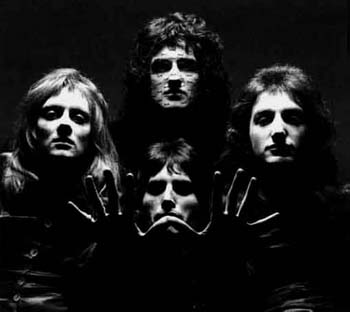

Queen are an English rock band formed in 1969 in London by guitarist Brian May, lead vocalist Freddie Mercury, and drummer Roger Taylor, with bass guitarist John Deacon joining the following year. Queen rose to prominence during the 1970s and are Britain's most successful band of the past three decades.[1]
The band is noted for their musical diversity, multi-layered arrangements, vocal harmonies and incorporation of audience participation into their live performances.[2] Their 1985 Live Aid performance was voted the best live rock performance of all time in an industry poll.[3]
Queen had moderate success in the early 1970s, with the albums Queen and Queen II, but it was with the release of Sheer Heart Attack in 1974 and A Night at the Opera the following year that the band gained international success. Since 1975, eighteen of the band's albums have reached number one on numerous charts around the world. Since 1973, they have released fifteen studio albums, five live albums, and numerous compilation albums.
Following Mercury's death in 1991 and Deacon's retirement later in the decade,[4] May and Taylor have performed infrequently under the Queen name. Since 2005, they have been collaborating with Paul Rodgers, under the moniker Queen + Paul Rodgers, which has led to Queen recording their first studio album in 13 years.
Jumat, 02 Mei 2008
Deep Purple

Deep Purple are an English hard rock band formed in Hertfordshire in 1968.[4] Along with Led Zeppelin and Black Sabbath, they are considered to be among the pioneers of heavy metal and modern hard rock,[5] although the members of the band have always refused to label themselves as heavy metal[6]. The band has also incorporated pop and progressive rock elements [5]. It was once listed by the Guinness Book of World Records as the world's loudest band,[5][7][8] and it has sold over 100 million albums worldwide.[9][10][11][12] Deep Purple was ranked #22 on VH1's Greatest Artists of Hard Rock program.[13]
The band has gone through many line-up changes and an eight-year hiatus. The 1968-76 line-ups are commonly labelled Mark I, II, III and IV. [14][15] Their second and most commercially successful line-up featured: Ian Gillan (vocals), Ritchie Blackmore (guitar), Jon Lord (keyboards), Roger Glover (bass guitar) and Ian Paice (drums).[8] This line-up was revived from 1984-89 and again in 1993 before the rift between Blackmore and other members became unbridgeable. The current line-up including guitarist Steve Morse has been much more stable, though Lord's retirement in 2002 has left Paice as the only original member.[16]
Led Zeppelin


Led Zeppelin were an English rock band that formed in September 1968. Led Zeppelin consisted of Jimmy Page (guitar), Robert Plant (vocals, harmonica), John Paul Jones (bass guitar, keyboards) and John Bonham (drums, percussion). With their heavy, guitar-driven sound, Led Zeppelin is regarded as one of the first heavy metal bands.[1][2] Their rock-infused interpretation of the blues and folk genres[3] also incorporated rockabilly,[4] reggae,[5] soul,[6] funk,[7] classical, Celtic, Indian, Arabic, pop, Latin, and country. The band did not release the popular songs from their albums as singles in the UK, as they preferred to develop the concept of album-oriented rock.[8]
Close to 30 years after disbanding following Bonham's death in 1980, Led Zeppelin continue to be held in high regard for their artistic achievements, commercial success, and broad influence. The band have sold more than 300 million albums worldwide,[9][10][11][12][13] including 111.5 million sales in the United States[14] and they have had all their non-compilation studio albums reach the U.S. Billboard Top 10.[15] Led Zeppelin are ranked No. 1 on VH1's 100 Greatest Artists of Hard Rock.[16] Rolling Stone magazine has described Led Zeppelin as "the heaviest band of all time" and "the biggest band of the 70s".[17]
On December 10, 2007 the surviving members of Led Zeppelin reunited (along with deceased drummer John Bonham's son Jason) for the Ahmet Ertegün Tribute Concert at The O2 in London.
Senin, 14 April 2008
Ratt

RATT
Formed 1981, U.S.A.
Albums:
1983 Ratt
1984 Out Of The Cellar
1985 Invasion Of Your Privacy
1986 Dancing Undercover
1988 Reach For The Sky
1990 Detonator
1991 Ratt & Roll 8191
1997 Collage
1999 Ratt
2002 The Essentials
2003 Metal Hits
2007 Tell The World: The Very Best Of Ratt
History:
Ratt was a hugely successful sleaze band that emerged from the Los Angeles glam scene. Branding their music "Ratt'n'Roll", the rodent rockers had hit after hit until the bottom fell out of the movement in the early 90's.
Originally formed in Los Angeles and known as Mickey Ratt, in 1981 the name was shortened to Ratt by founding member and vocalist Stephen Pearcy. Guitarists Warren DeMartini and Robbin Crosby, Juan Croucier (bass) and Bobby Blotzer (drums) rounded out the band. The self titled debut EP caused people to stand up and take notice, and led to a major label deal with Atlantic.
Out Of The Cellar went on to sell over 3 million copies, and with the help of the hit single "Round And Round", Ratt became one of metal's biggest names. Future albums never matched the debut's success, however platinum albums and sold out shows were the norm for the band during the late 80's. Top 40 albums and singles like "Lay It Down" and "Dance" were commonplace, however by 1990 things were about to change. Crosby left in 1990, and the band became a four piece with the release of "Nobody Rides For Free" for the Point Break soundtrack. Pearcy walked away shortly after to form Arcade, and Ratt quickly dissolved. Blotzer would join the super group Contraband for one album.
In 1997 Ratt decided to make their return as a four piece with Robbie Crane (Vince Neil solo) on bass. The first new material in years was released in 1999 and they hit the road with several other 80's bands on a highly successful tour. But in early 2000 Pearcy left again, leaving the band in limbo and forcing them to cancel tour dates. The remaining members are currently touring with Jizzy Pearl (from Love/Hate and L.A.Guns fame) and John Corabi (ex-Motley Crue and The Scream), but are now without a record label. Ratt vows to soldier on, but their mainstream acceptance days appear to be behind them. Sadly, the legendary Robbin Crosby lost his long fight with drugs, and succumbed to AIDS on June 6, 2002.
Links:The Official Ratt Pag
Langganan:
Postingan (Atom)